
I’ve often been asked: to what do I attribute SAM’s ongoing success? Frankly, the list is long, and at the very top of that list are all our extremely talented and dedicated teammates at SAM.
But as I sat down to write this letter, one attribute kept working its way to the top of my mind. And that’s our Golden Rule: We strive to be the investment and wealth management firm that we’d want to help secure our own future if our roles were reversed. Now, I know we’re not the only organization to have such a rule. But I doubt few firms use it as such a singularly guiding principle as we do here at SAM.
So, ten years into our journey together, we want to thank our clients for their continued support and trust in us. We endeavor to serve them and their families to the best of our abilities over the next ten years, and the decades after that and after that. Now onto our thoughts for 2026 and beyond…
Speaking of the Golden Rule…
When our Investment Committee convened to discuss this annual letter, the Golden Rule helped us very quickly identify a topic: what would we want to read about if the roles were reversed? Here is what we’d want, split into two parts:
-
Three years into a bull market, should I stay invested? If so, WHY?
-
More importantly, can SAM help grow my assets until this bull market ends while also protecting my assets once it does? If so, HOW?
Now I want to be clear. Only God (and maybe Stan Druckenmiller) can predict the future. And past performance continues to be no guarantee of future results. Still, these are important questions, and we’ll do our best to provide valuable answers.
Part 1: Should I Stay Invested?
If there’s only one thing you remember about our view of the current market environment it’s this: With valuations and expectations for future growth both high, we must see meaningful growth in the economy and earnings this year for asset prices to move higher from here. Full stop. This is not a market that will accept growth disappointments gracefully.
But here’s the second half of that view to remember: With that said, we believe you
should stay invested in the market this year. So, onto the important part… why? Two main reasons.
First, we expect this growth required to power markets higher will in fact materialize. Consider the macro backdrop that is supportive of such growth:
-
Monetary policy is accommodative. The Fed has dropped short-term rates 175 basis points already and it and the market expect even lower rates next year. We agree.
-
Fiscal policy is accommodative. The Treasury plans to continue to overspend its revenues, and 2026 should see major economic tailwinds from increased investment and tax incentives coming from the One Big Beautiful Bill Act.
-
Oil prices and bond yields are low, which benefit corporate earnings, particularly smaller and medium-sized businesses.
-
The bull market is spreading, and increasing breadth is absolutely a positive sign for the staying power of an upward market move. Since November 1st of last year through January 15th, the Magnificent 7 are down an average of 1.6%, while the S&P Equal Weight index is up 6.8% and small caps are up 11.4%.
-
Capital expenditures and investment are increasing, led in no small part by AI spending, which IT research firm Gartner expects will grow from $1.5 trillion in 2025 to more than $2 trillion in 2026. These outlays should be a boon for myriad supporting industries.
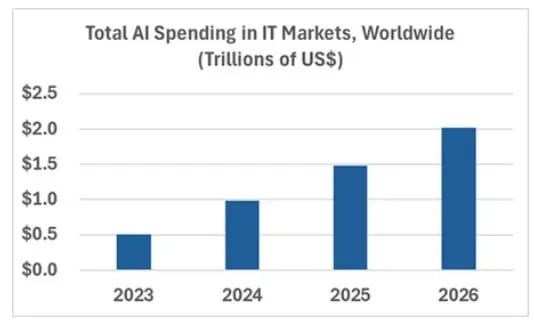
Source: Gartner, September 2025. Includes: AI services, software, hardware, and capital expenditures -
The economy, employment, and the consumer have proven resilient in 2025, all holding up better than consensus expectations throughout the year. What’s more, much of the GDP growth in 2025 has come from productivity gains (or higher GDP output per employed worker), growth that is far more sticky than other sources such as government investment, net imports, or labor force growth.
-
Finally, growth is not only strong, it’s likely accelerating. Analysts have raised S&P 500 profit estimates for next year, calling for 14% growth versus roughly 11% expected for 2025.
The second reason to stay invested is the simple fact that it’s exceedingly painful to be out of the market for any meaningful amount of time in the current environment. As you know, the federal government is deeply in debt, it continues to operate at a loss, and has no political will to correct these problems. As such, dollars will continue to be debased, inflation will continue to rise, and those who sit idly on the sidelines in cash will see their purchasing power and real net worth erode.
Said differently, in today’s money-printing environment, your best defense is a good offense. To defend your purchasing power and net worth, you must play offense and invest in productive assets (like world-class businesses) and superior stores of value (like gold).
To be certain, plenty of things could derail this market and change our outlook. A.I. spending could fall short of its promises for returns on investment, for productivity gains in the economy, or by eliminating far more jobs than it creates. Low- and middle-income consumers could finally get tapped out. And of course, the risk of black swan macro events and geopolitical upheaval can never be eliminated.
But on balance, the current environment is supportive of staying invested in highly productive assets that can protect your purchasing power and compound your wealth over the long run. Particularly when those assets are well-run, high-quality businesses with durable franchises that are likely to be bigger and more profitable a decade from now. So we recommend that most of our clients – those with at least a three-year investment horizon and a modest tolerance for risk – stay productively invested for the lion's share of their portfolios.
Part 2: Can I Invest for Asset Growth and Protection at the Same Time?
The short answer here is yes. It is possible to grow your wealth materially while also shielding it from much of the downside risk that comes when markets inevitably correct. Before I detail how we look to do that, I’d like to point out that this is exactly what we’ve done for clients over the past decade.
Recall that this is a decade that has seen three of the sharpest and quickest downturns that equity markets have ever experienced: during covid in 2020, the bear market of 2022, and the tariff tantrum in 2025. In all of these, SAM investment strategies saw much less volatility and significantly lower drawdowns than the market and their relevant benchmarks. More specifically, if we look back to just last year, at the lowest point for equities when the S&P 500 had dropped 19% from its high and was down 15% for the year, every one of the SAM investment strategies was either up for the year at the time, outperforming its benchmark, or both.
Two caveats. First, and again, past performance does not guarantee future results. And second, investing in this manner can limit returns if and when markets snap back quickly, as they did for us in 2025 from April on. Still, the point is, it’s possible. And we believe this type of positioning is prudent for most investors in 2026.
So how do we look to achieve this dual mandate of growth and protection? I’ll briefly point to four things…
1 ) Security selection matters. As we look ahead, we expect a greater dispersion of returns among companies even within the same industry. This bifurcation is already happening across many vectors: companies perceived as AI-beneficiaries are outperforming those deemed as AI-threatened, companies that cater to high income consumers are outperforming low-income-focused businesses, and so on. But we anticipate the dispersion between the haves and the have-nots to only increase in the year ahead.
One particular focus we have that we believe will provide added returns and ballast to your portfolios in 2026 is an even greater emphasis on the highest quality businesses. A lot of investors talk about owning quality businesses but don’t always define it. In our case, we’re focused on industry leaders with healthy margins, fortress balance sheets, strong returns on investment, and superior pricing power. We are confident that this mix of attributes not only benefits well-run businesses in good times, but is particularly valuable when markets and industries suffer through tougher times. We also find that very often these types of businesses tend to gain market share through the lows and come out even stronger on the other side.
2 ) Investing is seasonal, so be nimble and tactical. Staying mostly invested does not mean holding the same mix of assets all the time no matter what. In fact, there are plenty of times when whole swaths of assets should largely be avoided.
I recall vividly a conversation I had in late 2021 with a professional fixed income investor. I explained to him that we expected interest rates to move sharply higher and that as such, we weren’t going to own a single fixed-coupon bond across our strategies since the value of these bonds would likely crater (especially those with longer maturities). I was amazed at his response: he said he completely agreed with me and yet his desire to stay true to his “investment mandate” kept him from doing the same.
3 ) With the benefit of hindsight, this passive, “set it and forget it” mentality is clearly a terrible way to invest. And yet, that’s how so many investors are positioned. This provides us with opportunities, and we’ll look to continue to take advantage of them.
One last note here: in 2023, we enhanced our ability to be nimble and tactical through additional use of quantitative analytics and risk management. Our Tactical Select strategy is an optimized blend of SAM’s rigorous fundamental approach and multiple quantitative systems meant to help determine what’s best to own and when.
4 ) The real way to provide ballast to your portfolio – and enable you to be more fully invested in high-quality, productive assets – is to own a blend of assets that do not share the same set of risk factors. At SAM, we own many different assets with lower correlation – sometimes even negative correlation – to the overall market. Here is a brief description of a few…
-
Merger arbitrage investments. We tend to own the target of an M&A transaction when it trades at a material discount to the takeout price. Our return-to-risk equation here is “idiosyncratic,” meaning that success is based on whether the deal ultimately closes and not on if the overall market moves up or down.
-
Financial exchanges. We love owning financial exchange businesses in part because they are regulated, protected monopolies capable of generating strong growth and returns over long periods of time. We also love them because they tend to be less correlated with other stocks. You see, when volatility rises in markets and other businesses pull back or see their stocks sell off, financial exchanges tend to see increases in their transaction volumes and profits.
-
Gold investments. As a crisis hedge and superior store of value to fiat currencies, we’re seeing gold’s low-correlation benefits in real time. We’re pleased that many of you are invested in our strong-performing Gold strategy, and if you are underweight precious metals or sitting on too much idle cash, we welcome a discussion about how best to allocate to gold. Having said that, we caution that the huge surge in gold and silver over the past year is unlikely to continue in perpetuity; use this as a lower correlation supplement, not as the core of your investment portfolio.
5 ) Broaden your base. I’ve always marveled at this statistic: in the U.S., 87% of firms with revenue greater than $100 million are private. Put differently, public markets and public companies are only a small part of the overall economy.
Share of public and private U.S. companies
with revenue greater than $100 million
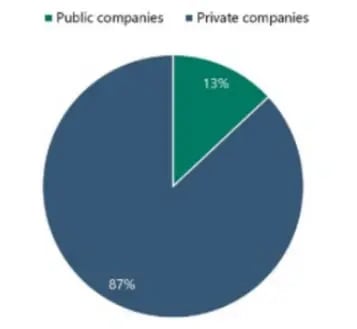
Source: S&P Capital IQ, 2025
This fact leads to one of main the reasons that we believe private markets and alternative investing can be so beneficial for many investors: it broadens your base of investments to a much wider universe. And in so doing, private markets can provide enhancements to each of the attributes above: greater security selection, tactical benefits, and lower overall correlation.
In addition, we believe that in today’s environment, broadening your base of investments to include alternatives provides another key benefit: better risk adjusted returns. Specifically, we’re seeing opportunities in private credit and private income-producing real estate to generate significantly higher total returns than their publicly traded corollaries. And that can be hugely beneficial to our efforts to grow and protect your wealth at the same time.
With that said, here are some “no free lunch” caveats. At present, investing in private markets the right way means that you’ll need to be an accredited investor (with at least $1 million or more in investable assets) and deal with delayed tax filing and K-1s. You’ll also need to be okay with part of your portfolio being illiquid for up to five years or more. As such, we caution that alternatives are not for everyone. But if you’re an accredited investor who’d like to learn more, please reach out to your SAM wealth advisor.
In closing, I’d like to note that the Golden Rule is the starting point for all that we do at SAM but it isn’t the destination. Instead, our ultimate compass for how to best manage your wealth is you, as it should be. And whether we focus your investments more on growing your wealth or protecting it will be as much about your goals and priorities as it is our outlook for what’s ahead.
Our entire team at SAM remains fully committed to helping investors like you and your family grow and protect your wealth and achieve your kind of financial success – in this decade and the next. If you would like to schedule a meeting with a member of our team to learn more about SAM, you can do so HERE, give us a call at (646) 854-2995, or visit our website at stansberryam.com/get-started/.
Prosperous investing,
Austin Root
Chief Investment Officer
On behalf of the SAM Investment Committee